

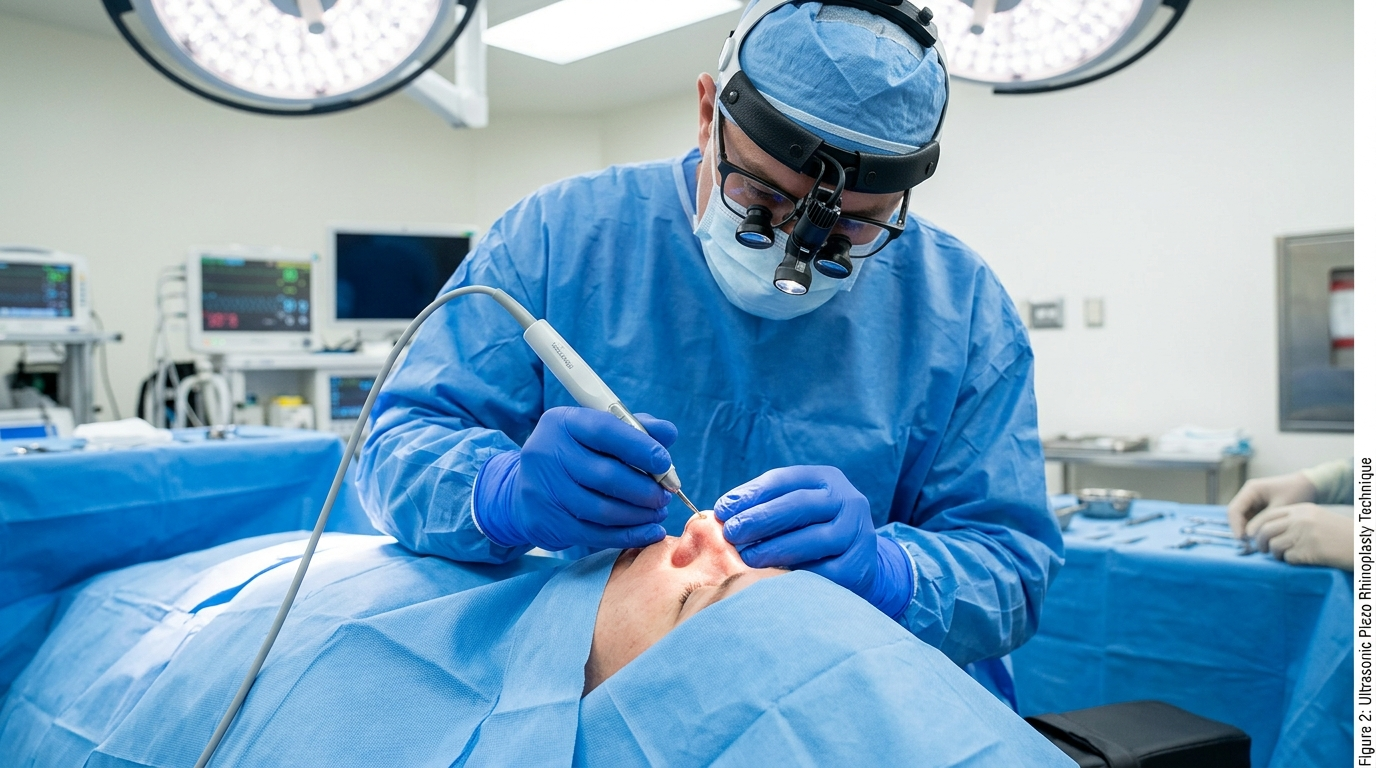
What Is Piezo Rhinoplasty? Better Surgery—or Simply a More Precise Bone Tool?
Updated and medically reviewed on . This page provides general education and cannot replace an examination, diagnosis or personalised surgical plan.
Short answer: Piezo is not a separate type of rhinoplasty. It is an ultrasonic surgical instrument designed for controlled work on nasal bone. Research suggests that it may reduce bruising, swelling, pain or mucosal injury at some early postoperative time points. It does not, by itself, guarantee a more natural, functional or durable result.
Online descriptions often present “ultrasonic rhinoplasty” as if the entire operation were performed by one advanced device. In reality, a rhinoplasty result depends on much more than the instrument used for the bony part of surgery. Skin thickness, cartilage support, tip strategy, septal and airway anatomy, facial proportions, surgical judgement and follow-up all matter.
This guide separates what the piezoelectric device actually does from marketing claims. It explains whether piezo is the same as open or closed rhinoplasty, when it may be relevant, where it has little influence, and what current systematic reviews can—and cannot—tell patients.
Piezo rhinoplasty at a glance
| What is piezo? | An ultrasonic system with selected tips that can cut or contour mineralised tissue, particularly nasal bone, in a controlled way. |
|---|---|
| Is it an open or closed technique? | No. Piezo is an instrument, not an access route. It may be used within an open or closed operation when appropriate. |
| What is the strongest evidence? | Some studies report less early swelling, bruising, pain, analgesic use or mucosal injury during the first days and first week. |
| What has not been proven? | It has not been proven to guarantee a more attractive, more natural, more functional or permanently superior final result. |
| Does every patient need it? | No. Its relevance depends largely on the planned bone work, individual anatomy and the surgeon’s method. |
How does a piezoelectric surgical device work?
A piezoelectric system converts electrical energy into rapid, very small mechanical vibrations. Using tips designed for different tasks, the surgeon can cut, thin or gradually contour bone. Irrigation is used during the procedure to help maintain visibility and manage heat at the working tip.
Its selectivity comes from the ability to work on mineralised tissue with suitable settings and technique. This can help limit trauma around the bone, but the phrase “it can never injure soft tissue” is an unsafe absolute. An unsuitable tip, excessive pressure, insufficient cooling or incorrect use can create risk with any surgical instrument.
Piezo is most often discussed when reducing a bony dorsal hump, repositioning nasal bones, narrowing the bony vault or correcting selected bony asymmetries. Most of the nasal tip, however, consists of cartilage and soft tissue. Tip support, septal correction and airway treatment therefore cannot be explained—or completed—by the piezo device alone.
Piezo is not the same as open or closed rhinoplasty
Open and closed rhinoplasty describe how the surgeon accesses and sees the nasal framework. Piezo describes one instrument that may be used during the bony phase of that plan. An operation can be open with piezo, closed with piezo, or use controlled conventional bone instruments through either approach.
This distinction matters because phrases such as “scarless piezo”, “closed ultrasonic rhinoplasty” or “fully ultrasonic nose surgery” can blend separate decisions into one label. Incision placement, bone work, cartilage manoeuvres, septal treatment and airway planning should each be explained on their own merits.
For the wider surgical framework, see rhinoplasty in Antalya. Our rhinoplasty preparation guide explains how medical history, photographs, examination and expectations are brought together before surgery.
When might piezo be useful?
The decision should follow the required bone work, not the popularity of a device name. Piezo may be one of the surgeon’s options when the plan includes:
- Controlled reduction of a substantial bony dorsal hump
- Narrowing or repositioning of the nasal bones
- Detailed correction of a bony asymmetry or deviation
- Carefully selected revision cases with a residual bony irregularity
- Progressive bone contouring under direct visual control
If the proposed change is limited mainly to the tip, alar base or soft tissue, piezo may not be central to the operation. Septal deviation or breathing difficulty requires a separate functional assessment. Previous surgery also changes the tissue environment; see revision rhinoplasty for that specific planning context.

Piezo versus conventional bone instruments
| Question | Piezo system | Controlled conventional osteotomy |
|---|---|---|
| How does it work? | Ultrasonic micro-vibrations delivered through task-specific tips | Osteotomes, rasps and other mechanical instruments |
| Visibility and precision | Can allow gradual work under direct visual control | Can be controlled and predictable in experienced hands |
| Early swelling/bruising | Some comparative studies show an advantage during the first week | Varies with the extent of surgery and surgical technique |
| Operating time | Not consistently shorter; setup and the learning curve may affect time | Varies with technique, case complexity and experience |
| Long-term outcome | The instrument alone does not determine the result | The instrument alone does not determine the result |
| Main determinant | Appropriate patient selection, an integrated plan, surgical execution and follow-up | |
This is not a “good tool versus bad tool” comparison. Conventional instruments have a long surgical history and can be effective when used with control. Piezo does not create automatic superiority in every anatomy, at every step, or in every surgeon’s hands.
What does the scientific evidence actually show?
The most consistent findings concern the early postoperative period. A 2024 systematic review of 12 randomised controlled trials involving 630 patients reported less oedema, bruising, pain or analgesic use and mucosal injury at certain early time points. It did not find a meaningful difference for every outcome, including bleeding and operating time, and the authors called for better long-term studies.
A larger 2026 meta-analysis using the GRADE framework assessed 19 studies and 905 patients. Some first-week measures of swelling, bruising, pain and mucosal safety favoured piezo, but the certainty of evidence varied by outcome. The analysis should not be interpreted as proof that piezo produces a better final aesthetic or functional result.
A 2022 systematic review similarly suggested lower early morbidity while warning about study quality, methodological differences and the limited availability of long-term patient-reported outcomes.
Questions current research does not fully answer
- Is the same advantage present in every nasal anatomy and operation type?
- Are patient satisfaction and airway outcomes better several years later?
- How strongly does each surgeon’s learning curve affect the comparison?
- Are all piezo tips, settings and operative protocols equivalent?
High-quality, standardised studies with long follow-up remain insufficient to answer all of these questions.
Recovery after piezo rhinoplasty is not instant
Using piezo does not remove the normal healing biology of rhinoplasty. Congestion, swelling, tenderness and varying bruising can still occur in the first days. The splint, taping, internal support and follow-up schedule depend on the scope of surgery and the surgeon’s protocol.
- First week: Early review and, when used, external splint management are priorities. Swelling still affects appearance.
- First weeks: Return to social activities varies; the nose may continue to look swollen.
- Following months: Refinement is gradual, especially at the tip and in thicker skin.
- Long term: Outcome should be assessed through aesthetic and functional follow-up, not a single early photograph.
Read the rhinoplasty recovery timeline and our guide to swelling and bruising after rhinoplasty for practical detail. The article does the nasal tip drop after rhinoplasty? explains why early and late tip changes are often misunderstood.
Ask more than “Do you use piezo?”
A useful consultation should go beyond the device name. These questions help reveal the actual plan:
- What are the main bone, cartilage, septal and airway findings in my nose?
- At which stage would piezo be used, and for what exact purpose?
- Why are you recommending an open or closed approach in my case?
- What controlled alternative would be available if piezo were not used?
- How might my skin thickness and healing behaviour affect the result?
- How should early reviews, my stay in Antalya and return travel be planned?
- How will aesthetic goals and breathing function be considered together?
Photographs and an online conversation may provide orientation, but they do not replace physical examination. International patients should not shorten their stay simply because a device is marketed as “less traumatic”. Travel and review dates should match the whole operation.
Common claims: marketing or evidence?
| Claim | A more accurate statement |
|---|---|
| “Piezo never harms soft tissue.” | Selective action may help limit trauma; zero risk is not a responsible claim. |
| “There will be no bruising.” | Early bruising may be lower in some studies, but anatomy, surgical extent and healing vary. |
| “Piezo means closed rhinoplasty.” | One is an access approach; the other is an instrument for bone work. |
| “The result is always more natural.” | Proportion, tissue, planning and execution—not a single device—shape naturalness. |
| “Recovery finishes much faster.” | Some early symptoms may be reduced, while tissue maturation still takes months. |
Conclusion: prioritise the plan, not the device label
Piezo is a valuable technology that can support controlled bone work in suitable cases. Its strongest evidence concerns possible reductions in some early measures of swelling, bruising and pain. It cannot honestly be presented as a standalone guarantee of natural appearance, improved breathing or long-term superiority.
The better question is not “Is piezo the best technique?” but “Which structures need to change in my anatomy, and how will each chosen tool serve that plan?” For an individual assessment, use the clinic’s appointment and contact page.
Scientific sources
- Armanfar et al. Piezoelectric versus conventional osteotomy in rhinoplasty: systematic review, meta-analysis and GRADE assessment. Aesthetic Surgery Journal, 2026.
- AlHammad et al. Piezoelectric versus conventional osteotomy in rhinoplasty: systematic review and meta-analysis of randomised controlled trials. Journal of Clinical Medicine, 2024.
- Gonçalves et al. Outcomes of piezosurgery in rhinoplasty: a systematic review and meta-analysis, 2022.
- American Academy of Otolaryngology–Head and Neck Surgery Foundation. Clinical Practice Guideline: Improving Nasal Form and Function after Rhinoplasty.
Frequently asked questions about piezo rhinoplasty
Is piezo rhinoplasty a separate operation?
No. Piezo is an ultrasonic surgical instrument used mainly during the bony phase of rhinoplasty. It does not describe the whole operation or replace a complete surgical plan.
Are piezo and closed rhinoplasty the same thing?
No. Open and closed describe surgical access; piezo describes an instrument that may be used for bone work. It can be used within either approach when appropriate.
Does piezo also shape the cartilage in the nasal tip?
Piezo is principally associated with mineralised tissue and bone work. Supporting and shaping tip cartilage requires other surgical manoeuvres.
Will I have no bruising after piezo rhinoplasty?
That cannot be guaranteed. Research suggests less bruising and swelling at some early time points, but the extent of surgery, anatomy and individual healing differ.
Does piezo guarantee a more natural result?
No. Natural appearance depends on facial proportion, skin, cartilage support, the full surgical plan and healing. One instrument cannot guarantee an outcome.
Is piezo rhinoplasty suitable for everyone?
No. It is most relevant when particular bone work is planned. Suitability requires medical history, examination, photographic analysis and functional assessment.
Does piezo shorten recovery?
It may reduce swelling, bruising or pain during the first week, but it does not remove the months-long maturation of nasal tissues. Reviews and activity advice remain individual.
Is the cost of piezo rhinoplasty different?
Cost is not determined by one device. Surgical scope, hospital and anaesthesia conditions, any functional work and follow-up all contribute; an individual plan is required.
Who decides whether piezo will be used?
The surgeon plans appropriate instruments after examination and discussion of goals. The patient should understand the reason, alternatives and limits; the decision should follow anatomy rather than a device label.