
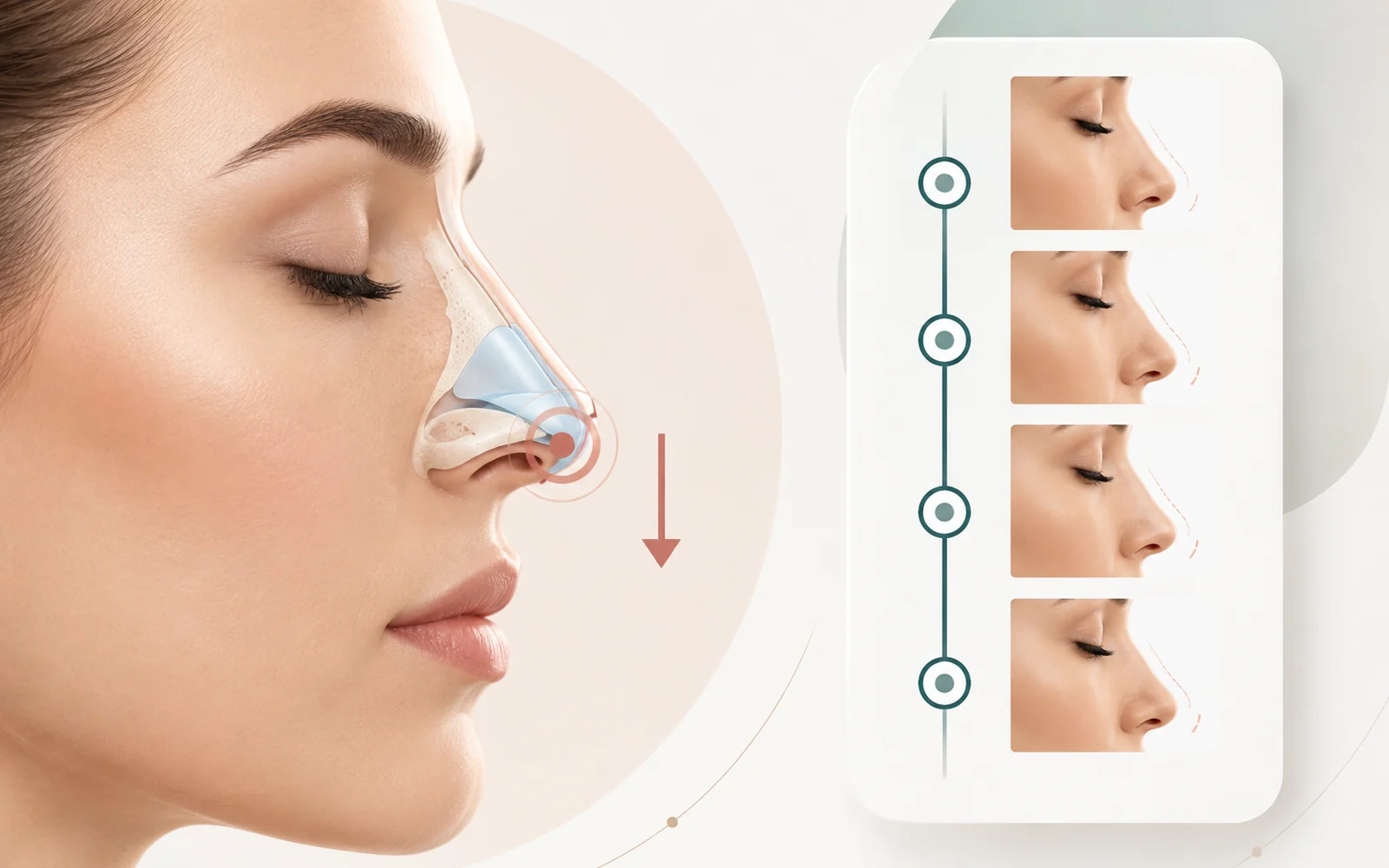

One of the most common questions after rhinoplasty is whether a tip that looks elevated soon after surgery will later “drop.” The early appearance is not the final result. Swelling, taping, tissue stiffness and temporary postoperative support can make the tip look more projected or rotated at first. As healing progresses, it normally settles into a softer and more natural position.
Normal settling is not the same as structural support loss. Timing, degree of change, symmetry, breathing, trauma history and comparison with standardised photographs all help distinguish the two.
The phrase is used for several different observations. A reduction in the angle between the tip and upper lip is a change in rotation. Reduced forward support is a change in projection. In other cases, camera angle, upper-lip movement or uneven swelling makes the tip appear lower even though the framework has not changed.
Assessment therefore includes front, profile and base views, the relationship between the bridge and tip, columellar show, nostril symmetry and breathing function—not a single selfie.
Immediately after surgery the tip can be firm and swollen. Even after the splint and tapes are removed, tissue stiffness may exaggerate the surgical position. As oedema resolves, the tip usually becomes softer, smaller and sometimes visually less upturned. This controlled change is generally described as settling.
True support loss may be greater than expected or progressively worsen. It may be accompanied by a clear downward rotation, loss of projection, asymmetry, altered columellar show or collapse during inspiration. Diagnosis depends on examination and change over time.
| More consistent with normal healing | May need earlier assessment |
|---|---|
| Slow, bilateral change over weeks or months | Sudden, marked or progressively worsening change |
| Softening as swelling decreases | Deformity or pain after trauma |
| Breathing is stable or improving | New blockage or collapse while breathing |
| Limited settling on standard photographs | Clear loss of rotation/projection or new asymmetry |
Rhinoplasty recovery is gradual. Swelling over the bridge may improve earlier, while the tip can remain firm and enlarged for longer, especially in thick skin. Rapid changes occur in the first weeks; subtler refinement continues over subsequent months. For many patients, a meaningful final assessment is made around one year, although thick skin, revision surgery and extensive tip work may require longer.
The timeline is individual. Surgical technique, skin envelope, cartilage support, scar behaviour, nicotine exposure and trauma all affect healing. See the rhinoplasty recovery timeline for a broader overview.
Thicker skin can retain oedema and hide definition for longer. Thin skin reveals fine contour changes sooner and may also reveal small irregularities. Read more in thick versus thin skin in rhinoplasty.
Tip position depends on the shape of the lower lateral cartilages, septal support, sutures and, when required, grafts. The goal is not simply to rotate the tip upward but to establish proportionate, durable support while preserving or improving nasal airflow.
Healing tissue can create temporary firmness or pulling. Smiling also changes the tip dynamically. A change seen only during animation is different from a persistent structural change at rest.
Early impact, forceful pressure, unapproved massage or premature use of heavy glasses may affect healing tissues. Not every touch causes damage, but visible change, bleeding, pain or breathing difficulty after trauma should be reported.
For expected swelling patterns, see swelling and bruising after rhinoplasty.
Even without an emergency sign, persistent concern deserves discussion. The team can decide whether photographs are enough or an examination is needed.
Swelling and scar tissue can mimic a contour problem during early recovery, so a cosmetic revision decision is usually not rushed. Most elective corrections are considered after tissues have matured. Earlier assessment is appropriate for major breathing problems, infection, trauma or a clear structural complication.
If revision is needed, the current anatomy, skin, remaining cartilage and airway are reassessed. Learn more on the revision rhinoplasty page.
This article provides general information and does not replace examination by your surgeon. Seek prompt advice for sudden deformity, heavy bleeding, breathing difficulty, high fever or significant skin-colour change after surgery.
It can be. As stiffness and swelling decrease, the tip may settle into a more natural position. The degree and timing should be judged individually.
Major changes occur early, but fine tip definition can continue to mature for about a year and sometimes longer in thick skin or revision surgery.
No. Facial muscles can move the tip temporarily. Persistent change at rest is assessed separately.
Contact your surgeon if there is visible change, bleeding, significant pain or breathing difficulty. Do not press or manipulate the nose to “put it back.”
No. Normal settling requires no revision. True structural or functional loss of support is evaluated after adequate healing unless an urgent complication is present.
Tip position should be assessed with standard photographs, examination and breathing function together.
Contact and appointmentRhinoplastyRevision rhinoplastyReviewed for medical accuracy: This page is prepared for patient education by the clinic of Op. Dr. Bahadır Çelik, Plastic, Reconstructive and Aesthetic Surgery Specialist in Antalya. Online information does not replace a personal examination; suitability, technique and recovery plan must be decided after medical evaluation.