
Published and medically reviewed: 31 August 2026. This page provides general information; personal suitability, surgical scope and follow-up can only be determined after a consultation.
Purpose of this guide: to look beyond the single label of “abdominal fat” after pregnancy or substantial weight loss and assess four separate concerns: excess skin, subcutaneous fat, abdominal-wall laxity and the area around the navel. For the procedure overview, see our tummy tuck surgery page; if your concern is mainly localised fat, see liposuction.
Pregnancy and major changes in weight do not affect every abdomen in the same way. One person may have a small fold of skin limited to the lower abdomen. Another may have laxity above and below the navel, rectus diastasis, a tethered caesarean scar and fat around the flanks. That is why choosing a procedure by the shortest scar, the easiest-sounding name or an online photograph can be misleading.
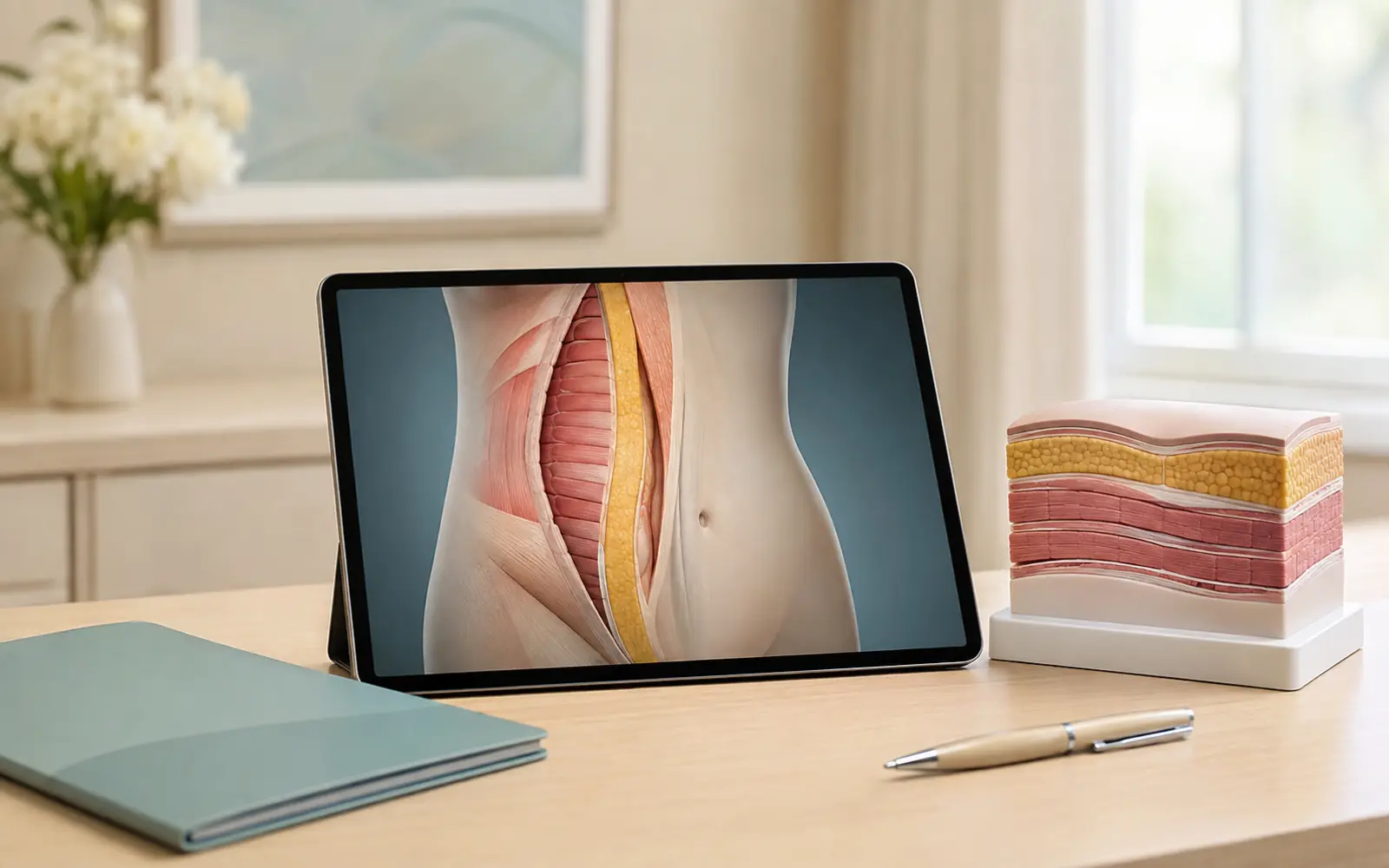
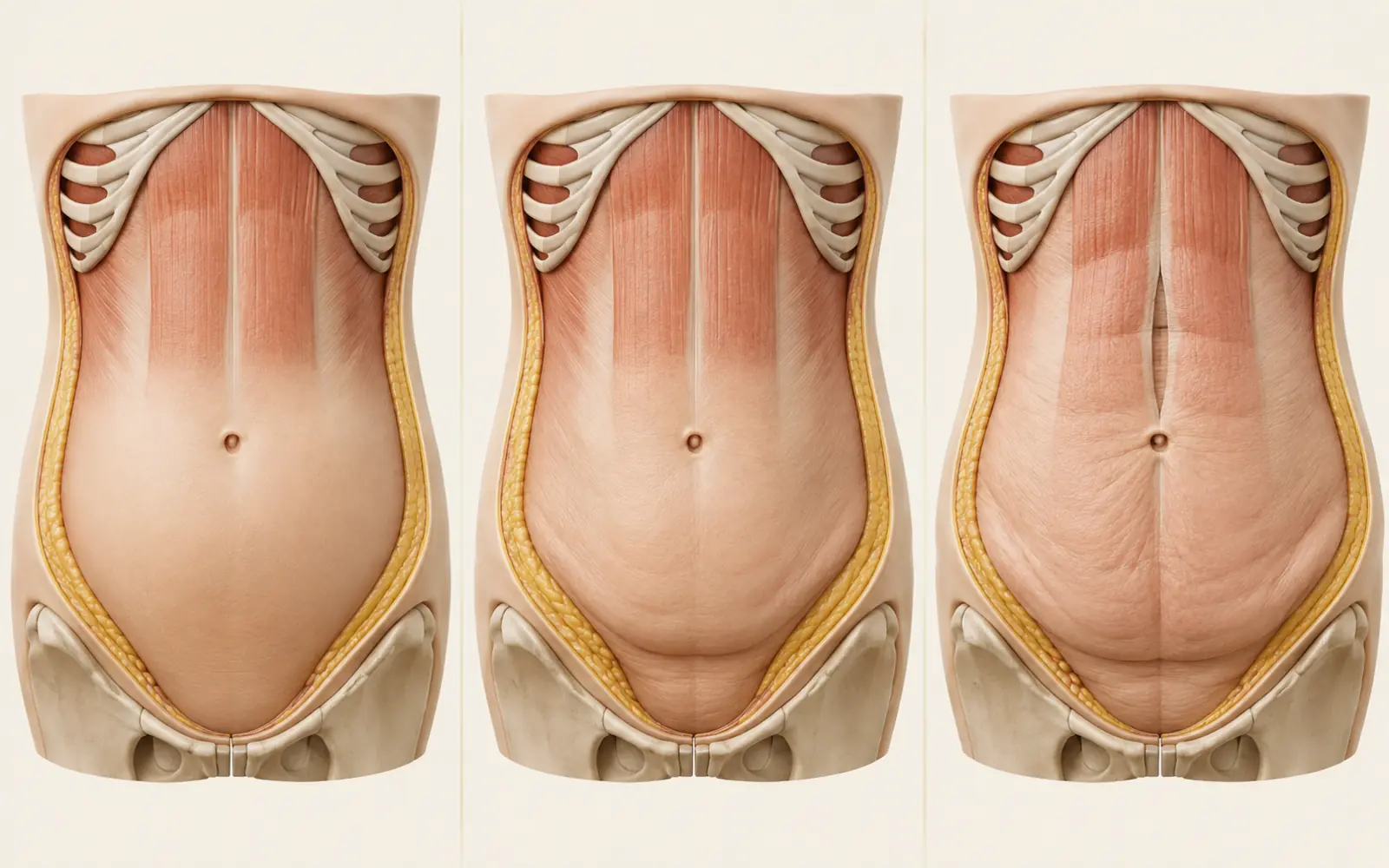
At least four layers influence the shape of the abdomen. The first is skin: how much elasticity remains and whether the excess is confined below the navel or extends more widely. The second is subcutaneous fat, the layer directly treated by liposuction. The third is the abdominal wall and its fascia. Separation between the rectus muscles can appear as a central bulge or doming. The fourth is the volume inside the abdominal cavity, including visceral fat; liposuction cannot reach or remove this deep fat.
During assessment, the surgeon observes how the skin behaves while standing and leaning forward, where fat is distributed, the position and shape of the navel, previous caesarean or abdominal scars, possible hernias and what happens when the abdominal wall contracts. Two people with the same body mass index may therefore need very different plans.
| Option | Main target | What it does not correct by itself | Typical planning clue |
|---|---|---|---|
| Liposuction | Localised subcutaneous fat and contour | Significant excess skin, rectus diastasis or visceral fat | Stable weight, good skin elasticity and fat as the main concern |
| Mini tummy tuck | Limited excess skin below the navel and, in selected cases, the lower abdominal wall | Laxity extending well above the navel | The change is genuinely concentrated in the lower abdomen |
| Full tummy tuck | Broader laxity above and below the navel and, when needed, the abdominal wall | Visceral fat or the need for further weight loss | More extensive change after pregnancy or major weight loss |
| Combined plan | Skin removal and wall repair plus selected contouring of the flanks or adjacent areas | Unlimited fat removal or a combination suitable for every patient | Only when blood supply, operating time and clot risk remain acceptable |
This table is not a prescription. “Mini” does not guarantee a tiny incision or a simple recovery; the amount of skin to be removed influences scar length. A full tummy tuck does not automatically require the same muscle repair, navel technique or liposuction in every patient.
During pregnancy, the skin and abdominal wall expand to accommodate a growing volume. Some tissues retract gradually after delivery, while excess skin, stretch marks, a change in navel shape or rectus diastasis may remain. A caesarean scar can also become tethered, creating a step or fold in the lower abdomen. These findings are related, but they are not corrected by one universal technique.
A mini tummy tuck may be considered when excess skin is genuinely below the navel, the upper abdominal skin is reasonably firm and wall laxity is limited. In many mini procedures, the navel is not cut around and brought through a new opening. However, the amount of skin movement and the exact technique vary, so it would be inaccurate to promise that the navel can never be affected.
If laxity reaches the upper abdomen, tissue gathers around the navel or separation extends along the abdominal wall, a full tummy tuck may create a more balanced correction. Lower abdominal skin is removed, upper skin is advanced downwards and the navel commonly emerges through a new opening in the redraped skin. The rectus muscles themselves usually do not need to be cut; when appropriate, the fascia over them is brought towards the midline with sutures.
If skin quality is good, the abdominal wall is firm and the main issue is pinchable subcutaneous fat, liposuction may be sufficient. Removing too much fat beneath loose skin, however, can leave the surface emptier or more irregular. Device names such as ultrasound-assisted or laser-assisted liposuction do not override the basic requirement for suitable skin and anatomy.
Following substantial weight loss, excess tissue may not be confined to the front. It can continue around the flanks, back and hips, creating a three-dimensional problem. A hanging lower abdominal apron may cause difficulties with hygiene, clothing, mobility or recurrent irritation. Depending on the direction and extent of excess, a standard or extended tummy tuck, a vertical fleur-de-lis component or a body lift may be discussed. A longer scar is not automatically better, and a shorter scar is not automatically safer; the pattern should match the tissue that needs removal.
If weight loss is still continuing, early contour surgery can be followed by renewed laxity. Nutritional deficiency, anaemia, diabetes and previous bariatric surgery may affect wound healing. The aim is therefore not an arbitrary number on the scale, but a sustainable stable weight and health that is suitable for elective surgery.
A reliable assessment cannot be completed from a single front-view photograph. The consultation covers pregnancies, breastfeeding, plans for another pregnancy, weight history, medicines and supplements, all sources of nicotine, personal or family clot history, previous abdominal surgery and daily activity. If a hernia is suspected, further examination or imaging may be required.
An online preliminary consultation can help with travel and an approximate plan, but it cannot replace hands-on assessment of skin elasticity, the abdominal wall and hernias. The final method and expected scar length are confirmed after an in-person examination.
There is no universal number of months for every patient. After childbirth, the body needs time to recover, breastfeeding should have finished and weight and hormonal changes should have settled. Pregnancy is not necessarily impossible after a tummy tuck, but it can stretch the skin and abdominal wall again; surgery is therefore commonly considered after plans for further pregnancy are complete. Timing should also take obstetric and general health advice into account.
After weight loss, the weight should show meaningful stability and nutrition should be adequate. For patients who have had bariatric surgery, protein status, iron, vitamin B12, folate and other possible deficiencies are assessed with the relevant clinicians. Reaching a target weight does not by itself mean that someone is ready for surgery.
| Period | What may be expected | Planning note |
|---|---|---|
| First days | Swelling, tightness, pain, a flexed posture and, in some plans, drains | Early safe walking, medication, wound care and clot warnings follow the surgeon’s protocol. |
| First 1–2 weeks | Bruising, numbness, restricted movement and review appointments | Desk work varies by scope and individual; driving and flying require clearance. |
| First 4–6 weeks | Gradual reduction in swelling; pulling if wall repair was performed | Heavy lifting, strenuous exercise and compression are managed with personal instructions. |
| Following months | Scar maturation, softening of tissue and gradual contour settling | An early appearance is not the final result, and a scar does not disappear completely. |
Liposuction incisions are usually shorter, but liposuction still has a recovery period and risks. A full tummy tuck normally leaves a longer low scar and may include a scar around the navel. A mini scar is often planned shorter, although the amount of skin excision can change this. Position is discussed in relation to underwear or swimwear; an invisible scar or millimetre-perfect symmetry cannot be guaranteed.
Possible complications include bleeding, infection, seroma, haematoma, wound separation, delayed healing, impaired circulation to skin or fat, prominent scarring, asymmetry, numbness, persistent pain, contour irregularity and revision surgery. Deep-vein thrombosis and pulmonary embolism are uncommon but serious. Individual risk changes with surgical scope and duration, BMI, nicotine, clot history, hormone use, mobility and other medical conditions.
A safety plan includes an appropriate operating facility, anaesthetic assessment, personalised bleeding and clot-risk assessment, early mobilisation, mechanical or medication prophylaxis where indicated, and accessible follow-up. Combining more procedures in one session is not always the safer or better choice. Surgery may be staged when the additional operating time or risk is not acceptable.
Sudden shortness of breath, chest pain, marked swelling or pain in one leg, uncontrolled bleeding, rapidly increasing abdominal swelling, high fever, worsening redness or escalating pain require urgent assessment. Do not wait for a routine appointment; contact the surgical team or emergency medical services immediately.
Flight and hotel duration cannot be decided from the operation name alone. The plan must allow for in-person examination, tests, early postoperative reviews, possible drain care and safe mobility. Both major surgery and air travel can increase clot risk. Avoid buying an inflexible return ticket before the surgeon confirms the examination and follow-up schedule. Sea, sun, intensive sightseeing and childcare should not be built into the early recovery days.
No. Its effective area is mainly below the navel. If excess skin or diastasis extends into the upper abdomen, choosing the shorter operation may leave an incomplete or unbalanced correction.
Liposuction removes subcutaneous fat. The degree of skin contraction depends on individual elasticity; it does not excise significant loose skin. Poorly elastic skin can look looser after fat removal.
No. Although removed tissue can change the number on the scale, the purpose is contouring at a stable weight, not obesity treatment or weight reduction.
In many aesthetic plans, the muscle tissue is not cut. The fascia covering the muscles is brought towards the midline with sutures. The need and exact technique depend on examination.
There is no single mandatory interval. Physical recovery, breastfeeding, weight stability, future pregnancy plans and general health are considered together.
Pregnancy can often still occur, but it may stretch the skin and abdominal wall again. Tummy tuck is therefore usually considered once further pregnancy plans are complete.
Yes, in selected patients. The region and extent of liposuction depend on skin blood supply, operating time and the overall risk assessment; it is not an automatic addition.
No. A scar may fade and soften with time but does not vanish. Its length and appearance depend on tissue excess, incision planning and individual healing.
You can arrange an in-person consultation or an online preliminary discussion to review skin excess, subcutaneous fat, the abdominal wall, previous scars and individual health risks together.
Op. Dr. Bahadır Çelik: This page was prepared for patient education at the Antalya clinic of Plastic, Reconstructive and Aesthetic Surgery Specialist Op. Dr. Bahadır Çelik. Online information cannot replace diagnosis, an in-person examination or an individual surgical plan.
This content is for general patient education. Suitability, procedure scope, risks and follow-up are determined after examination.