

Published and medically reviewed: 26 August 2026. This page provides general patient information; diagnosis and an individual surgical plan require an examination.
Purpose of this guide: To answer “Will a nose operation also help me breathe?” by explaining the relationship between the septum, nasal valves, turbinates, external framework and nasal lining. For broader aesthetic planning, see rhinoplasty in Antalya; if you have had previous surgery, see revision rhinoplasty.
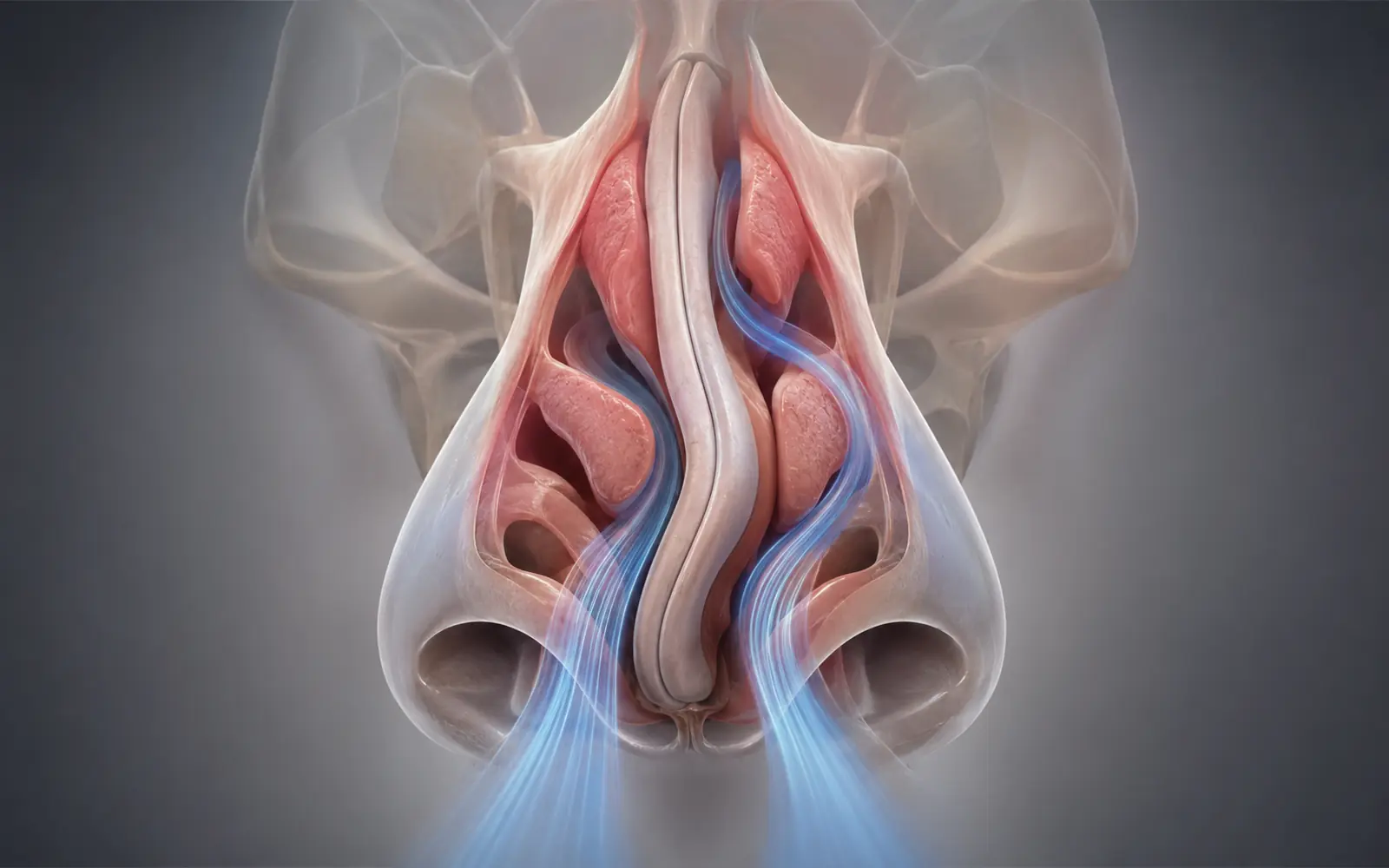
Septorhinoplasty combines correction of the nasal septum—the internal wall dividing the two nasal passages—with planned changes to the external nose. Its purpose is not simply to create a straighter profile or a more symmetrical appearance. When structural causes of obstruction are correctly identified, protecting or improving the airway becomes part of the same operation.
The septum is made of cartilage and bone and separates the right and left nasal cavities. A deviation may be present from development, become more noticeable during growth or follow an injury. A bent area can narrow the airway, but the degree of visible deviation does not always match the severity of a person’s symptoms.
If the external nasal framework is also crooked, the middle vault is narrow or a sidewall moves inward during inspiration, septoplasty alone may not address the whole problem. Septorhinoplasty considers the internal septum and the external support system together. Functional and aesthetic goals are discussed separately, then combined so that one does not unnecessarily compromise the other.
| Procedure | Main focus | Key planning question |
|---|---|---|
| Septoplasty | Straightening obstructing parts of the internal septum | Is the septum the main cause, or are other areas also involved? |
| Rhinoplasty | External nasal shape and proportions | How will the airway be preserved while shape changes? |
| Functional rhinoplasty | The nasal valves and structural sidewall support | Does the middle vault or lateral wall need support? |
| Septorhinoplasty | The septum and external framework in one plan | How can functional and aesthetic goals be balanced on the same structure? |
The terms are sometimes used loosely. The operation’s name is less important than documenting which anatomical findings cause concern and why each structure may need treatment. “The septum will also be corrected” does not describe an identical operation for every patient.
The strongest indication is a sensible match between persistent symptoms and examination findings. Constant blockage on one side, post-traumatic crookedness, exercise-related airflow limitation, habitual mouth breathing or inward movement of a nostril sidewall may justify a structural airway assessment.
Allergic or vasomotor rhinitis, chronic sinusitis, polyps, rebound congestion from decongestant sprays and obstructive sleep apnoea can require different treatment. Mucosal swelling may alternate from side to side through the day; septal surgery does not remove an allergy. A symptom that responds to appropriate medical treatment should not be labelled surgical on appearance alone.
The consultation is more than a set of profile photographs. Your surgeon asks whether blockage is unilateral or bilateral, constant or variable; whether there has been trauma or previous surgery; and whether allergy symptoms, nasal sprays, snoring, sleep quality or exercise intolerance are relevant. A validated patient-reported measure such as the NOSE scale can help record baseline severity and later change.
The intranasal examination considers the front and back of the septum, turbinates, lining, crusting, polyps and other possible causes. The nasal valves are assessed during normal inspiration and with support manoeuvres. Endoscopy is not compulsory for everyone but can be useful when the posterior nasal cavity or another disorder needs evaluation. CT is also not a routine cosmetic-rhinoplasty test; it is reserved for a separate clinical indication such as suspected sinus disease.
External assessment includes frontal, lateral, oblique and base views; the nasal bones, middle vault, tip support, nostrils, skin thickness and the proportions of the face. Computer simulation can help communication, but it is not a guaranteed preview of the final result.
Planning is not a sequence of “cosmetic work first, breathing second.” Narrowing a bridge, repositioning nasal bones, changing the middle vault or rotating the tip can influence airflow. The amount of cartilage preserved or repositioned, structural grafts when indicated and the supporting portions of the septum must therefore be considered together.
Obstructing cartilage or bone may be conservatively removed, reshaped or supported in a straighter position. Enough structural cartilage must remain to support the bridge and tip. Severe anterior or complex deviations can require more extensive reconstruction than a limited septoplasty.
If middle-vault narrowing or lateral-wall weakness contributes to obstruction, spreader-type support, sutures or lateral-wall grafts may be considered according to anatomy. The same graft is not appropriate for every nose.
If turbinate enlargement is persistent and has not responded to suitable medical treatment, a mucosa-preserving reduction may be discussed. Turbinate treatment is a separate decision, not an automatic component of septoplasty.
Open and closed describe access routes, not guaranteed levels of quality. The location of deviation, need for valve support, revision history and the surgeon’s experience determine the appropriate approach. Broad claims that one is always more functional, natural or durable are misleading.

| Period | Common experiences | Planning note |
|---|---|---|
| First 24–72 hours | Pressure, slight drainage, mouth breathing and swelling | Elevation, medication and bleeding advice follow the surgeon’s instructions. |
| First week | External cast and/or internal silicone splints, bruising and blockage | Review and removal dates depend on what was performed. |
| Weeks 2–6 | Fluctuating airflow, crusting and tip firmness | Exercise, impact and glasses require individual clearance. |
| Following months | Gradual settling of swelling, airway and shape | Tip and thick-skin changes can take longer. |
The nose may feel blocked immediately after surgery; this does not show that the operation has failed. Swelling, dried secretions and internal splints can temporarily reduce airflow. Saline care and cleaning instructions are individual. Forceful cleaning, starting non-prescribed medication or continuing sprays without advice can disrupt healing.
Return to work and social activity depends on the extent of surgery and the nature of your work. See the related guides to returning to work and swelling and bruising.
Possible risks include bleeding, infection, septal haematoma, internal adhesions, septal perforation, altered smell, numbness, skin or wound-healing problems, asymmetry, persistent obstruction and revision surgery. When valve reconstruction or grafts are used, visibility, displacement or contour irregularity are additional considerations.
The aim is not to turn the nose into a maximally open tube. It is to reduce relevant structural narrowing while respecting nasal physiology and a shape compatible with the face. Perfect right-left equality, no postoperative swelling or freedom from any future procedure cannot be guaranteed.
An online preliminary consultation can help travel preparation but cannot replace an internal examination. Allow time for face-to-face assessment, anaesthetic preparation, surgery, early review and any cast/splint care. Avoid a non-changeable return booking before the scope and review date are confirmed. The early recovery period is not suitable for swimming, strong sun, intensive sightseeing or sport.
No. Septoplasty focuses on the internal septum. Septorhinoplasty addresses the septum together with the external framework and, when needed, nasal-valve support.
No result can be guaranteed. Meaningful improvement may occur when symptoms match structural narrowing, while allergy, rhinitis, sinus disease and other causes can need separate treatment.
Yes, in an appropriate patient. Because both goals affect the same cartilage-and-bone framework, they must be planned together so an aesthetic change does not unnecessarily narrow the airway.
No. Depending on the operation, silicone internal splints, absorbable material or no packing may be used. The choice is procedure-specific.
Neither route is universally superior. The location of the deviation, need for valve support, revision history and the surgeon’s plan determine the appropriate access.
Blockage from swelling, crusting and splints is common at first. Airflow often improves unevenly over several weeks, and final functional assessment requires longer follow-up.
No. Surgery is not compulsory when the appearance is acceptable to the person and there is no meaningful airway problem. The decision combines symptoms, examination and individual goals.
The duration depends on the operation, early review and cast or splint plan. Confirm travel only after the face-to-face assessment and surgical schedule are complete.
Arrange an in-person or online preliminary consultation to discuss breathing symptoms, the septum, nasal valves, turbinates and aesthetic goals together.
Op. Dr. Bahadır Çelik: This page was prepared for patient education at the Antalya clinic of Plastic, Reconstructive and Aesthetic Surgery Specialist Op. Dr. Bahadır Çelik. Online information cannot replace diagnosis, an ENT assessment when indicated or an individual surgical plan.
This content is for general patient education. Suitability, procedure scope, risks and follow-up are determined after examination.