

Every breast augmentation, lift or reduction that crosses the skin leaves a scar. Its position, length and how inconspicuous it becomes depend on the operation and individual healing. This guide explains normal maturation, sensible aftercare and signs that need prompt review.
Published: · Updated: · Medically reviewed by Op. Dr. Bahadır Çelik
Scar location deserves the same careful discussion as shape and volume. In breast surgery planning in Antalya, there is no single incision pattern for everyone. Breast anatomy, skin excess, nipple position, the intended change and the safest technique must be considered together. Another patient’s photograph cannot predict your scar.
This page provides general patient education. Only the surgeon who examines you should decide when to shower, change dressings, start a product or massage, wear a support bra and resume activity.
When an incision passes through the skin, the body repairs it by laying down collagen. The resulting repair line is a scar. Surgical planning can place incisions within a natural fold or colour transition so they are less conspicuous, but it cannot remove the biology of healing. A scar that is pink, red, firm or slightly raised in the early months can still be going through normal maturation.
Promises of “no scar,” “invisible scars” or disappearance by a fixed date are misleading. A sensible goal is safe wound closure followed by gradual settling, with individual treatment if the scar behaves abnormally.
Scar length is related to the work required, not simply a surgeon’s preference. Removing more loose skin or moving the nipple farther may require a longer access route. The shortest incision is not automatically the safest operation or the best shape.
For breast augmentation, the incision is commonly placed in the inframammary fold and may sometimes sit around the areola or in the armpit. Implant characteristics, anatomy, the existing fold and safe visual access influence the choice. An inframammary incision is designed to lie within the natural crease.
A breast lift may use a line around the areola alone. With greater skin excess, a vertical line and sometimes a horizontal line in the fold are added. These incisions allow excess skin to be removed, the nipple to be repositioned safely and the breast tissue to be reshaped.
Breast reduction and lift usually involve a periareolar and vertical incision; an inverted-T pattern may be needed for a larger volume or more skin excess. The scars reflect the access needed to reduce weight and create the new contour.
The timetable is approximate and varies with the procedure, closure method and individual biology. A scar is not expected to reach its final appearance within a few weeks.
| Period | What may be normal | Main priority |
|---|---|---|
| 0–2 weeks | The line may look closed while its strength remains low. Mild redness, tightness and crusting can occur. | Keep the dressing clean and dry as instructed; follow medication and movement restrictions. |
| 2–6 weeks | Closure progresses. The line may appear pink or darker, and sensation can change. | Consider a scar product or massage only after approval; avoid pulling and friction. |
| 6 weeks–3 months | Active collagen production can make the scar redder, firmer, itchy or more raised. | Attend follow-up and report rapid thickening or growth beyond the incision. |
| 3–12/18 months | During maturation, many scars soften, flatten and move closer to the surrounding skin colour. | Continue sun protection and allow enough time before judging the final result. |
Similar incisions can heal differently. Genetics and a history of raised scars or keloids matter. Mechanical tension, wound separation, infection, nicotine-related impairment of blood supply, poorly controlled diabetes, intense sun exposure and individual skin responses may also influence the result.
Age or skin colour alone does not determine the outcome. Tell your surgeon if a piercing, vaccination, caesarean section or previous operation produced a scar that expanded beyond the original wound. Smoking, vaping and all nicotine products should be discussed honestly so a safe cessation plan can be agreed.
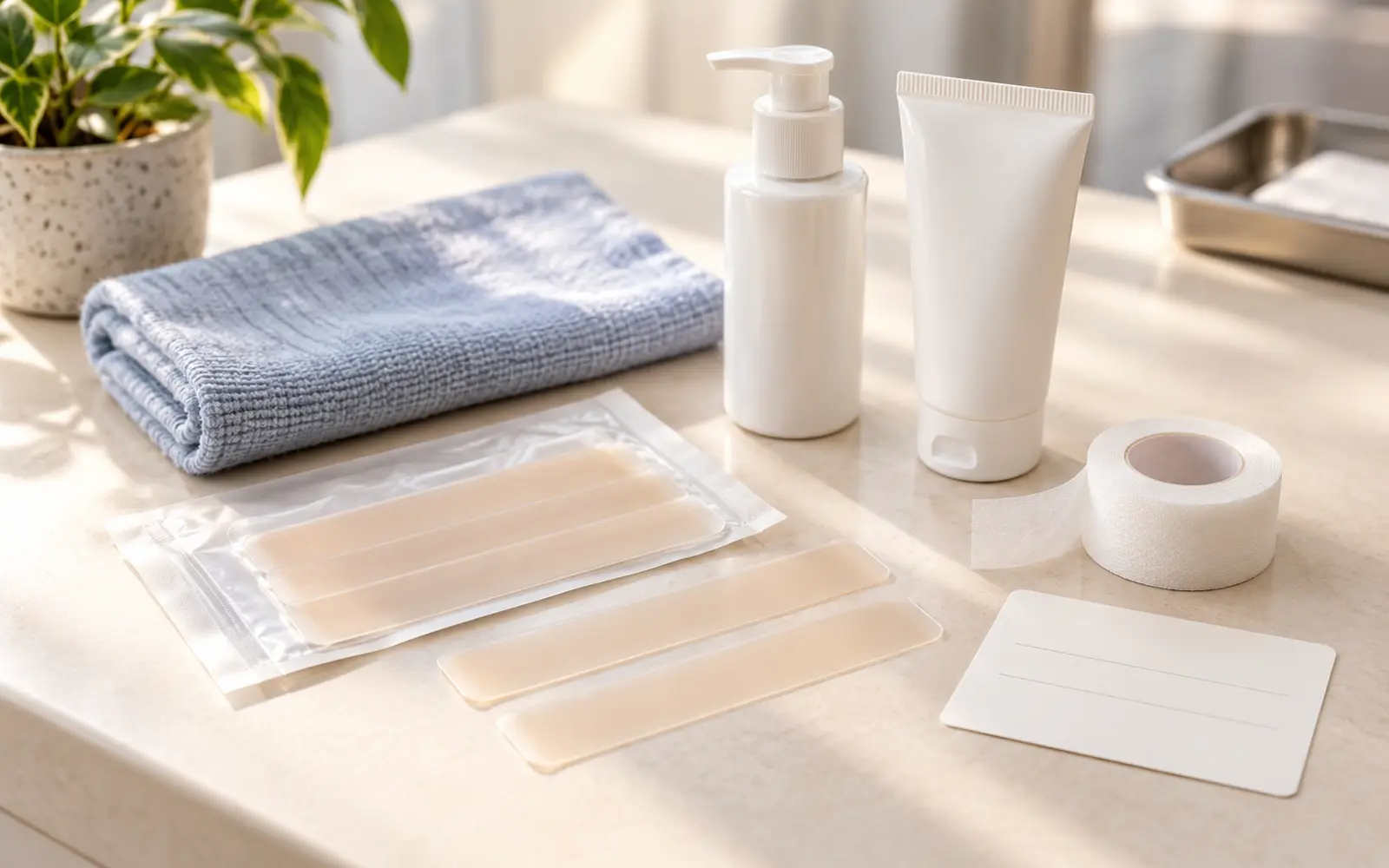
The first goal is uncomplicated healing, not cosmetic treatment. Follow the plan for dressings, prescribed medicines, showering, support garments and arm movement. Do not pick crusts or put a cosmetic cream on an open or draining wound.
Silicone may be suggested on a fully closed wound to help prevent or reduce a hypertrophic scar in selected patients. Reviews suggest possible benefit, but certainty and the ideal regimen remain limited. Silicone must not be placed on an open wound. Your surgeon should specify the start date, product and daily duration. Stop and seek advice if irritation develops.
Massage is not appropriate for everyone or every stage. Starting too early or pressing too hard can stress the incision. If advised after full closure, ask the team to demonstrate pressure and frequency. Medical or paper tape may sometimes reduce tension, but the skin should be monitored for allergy or irritation.
New scars can darken with ultraviolet exposure. Once the incision is healed, cover it with clothing and use broad-spectrum sunscreen if your surgeon agrees. Support-bra use, heavy lifting and return to exercise are procedure-specific. Feeling well early does not mean deeper tissues have recovered full strength.
A hypertrophic scar can be raised and firm but generally stays within the original incision. A keloid grows beyond the wound boundaries. Not every red or raised early scar is a keloid; a normally maturing scar may look prominent for several months.
Do not diagnose the scar by comparing photographs online. Early review can help determine whether observation, silicone, pressure, injection, laser or another approach is reasonable. Capsular contracture affects the tissue capsule around an implant and is different from a skin-incision scar.
An early complication should not be watched under the assumption that scar cream will resolve it. A photograph can help triage, but it does not replace an examination when one is needed. Do not start leftover antibiotics, steroid cream or herbal remedies on your own.
Treatment depends on the scar’s type, age, colour, thickness, symptoms and the patient’s keloid tendency. Silicone, pressure, steroid injections, selected laser procedures or surgical revision may be considered. No treatment produces the same result in every scar, and a one-session guarantee is unrealistic.
Revision for appearance alone is often delayed until maturation because early redness and firmness may improve. Wound separation, infection or a rapidly enlarging pathological scar is assessed sooner. Revision creates another incision; it does not erase a scar, but aims for a better line under improved conditions.
At consultation, discuss which operation meets the anatomical goal, where the incision is likely to sit, its approximate length, previous scar behaviour, nicotine use and the recovery time available. Insisting on a short scar can limit necessary skin removal and compromise shape or safety.
The main breast surgery page explains how augmentation, lift and reduction address different needs. An examination is required for a personal incision plan and risk discussion; online information cannot diagnose or choose an operation for you.
No. An incision through the skin leaves a permanent scar. Many scars fade, soften and become less conspicuous, but complete disappearance cannot be guaranteed.
Scar length depends on the skin and tissue work required. Augmentation alone usually needs a shorter incision; lifts and reductions may require periareolar, vertical and sometimes inframammary lines.
Silicone should be used only after the wound is fully closed and the surgeon approves it. Do not apply it to an open, crusted or draining incision; the start date varies.
Massage may be advised after closure for some patients, but it is not appropriate for everyone or early healing. Ask your surgeon to specify timing, pressure and frequency.
No. Selected treatments may improve colour, thickness or firmness in an appropriate scar, but no method completely erases it or guarantees the same outcome.
A piercing, vaccination or operation scar that grew beyond the original wound can suggest risk. Assessment depends on your history and examination.
New scars remain prone to colour change for many months. Once healed, continue clothing cover and broad-spectrum sunscreen if approved by your surgeon.
Contact the surgical team promptly for spreading redness or warmth, increasing pain, discharge, wound opening, fever or sudden one-sided swelling.
Your anatomy, goals and previous scar behaviour can be assessed together to plan the operation, incision positions, recovery and aftercare.
Contact and appointmentThis patient-education content was reviewed by Op. Dr. Bahadır Çelik, Specialist in Plastic, Reconstructive and Aesthetic Surgery. It does not replace examination, diagnosis or individual medical advice.
Published 20 October 2026 · Last medical and technical review 22 October 2026 · Source links were checked for access and relevance.