

A thin capsule around an implant is normal. Capsular contracture occurs when that tissue tightens and causes increasing firmness, shape change or pain.
Last updated: 27 September 2026 · Medical review: Op. Dr. Bahadır Çelik
Anyone considering breast augmentation in Antalya, or living with breast implants, should first understand an important distinction. The body normally forms a thin layer of scar tissue around an implant. This layer is called the capsule and, by itself, is not a complication. Capsular contracture develops when that capsule thickens and tightens around the implant, causing increasing firmness, a change in shape or pain.
Contracture may affect one or both breasts. Not every firm breast has capsular contracture, and early postoperative swelling or chest-muscle tension does not automatically represent a permanent problem. A reliable assessment considers when the change began, whether it is progressing, pain, asymmetry, implant position and any signs of fluid or infection.
The most common change is a breast that gradually feels firmer. The implant may appear to sit higher, the breast may become unusually round or compressed, and a new difference between the two sides may develop. More advanced contracture can cause tenderness when touched or pain at rest. Symptoms often progress slowly, although some people notice a change over a shorter period.
New firmness can also be associated with implant rupture, displacement, fluid collection, infection or a condition in the person’s own breast tissue. A photograph cannot establish the diagnosis, and squeezing the breast at home is not a safe way to assign a grade. New one-sided swelling, a fluid sensation, a lump, redness or significant pain—particularly years after surgery—needs an in-person assessment.
Plastic surgeons commonly use the Baker classification to describe examination findings in a shared language. It is useful, but it does not replace symptoms, implant records or imaging when imaging is indicated.
| Grade | General description | Practical meaning |
|---|---|---|
| Baker I | The breast is soft and looks natural. | This is considered a normal capsule response, without clinical contracture. |
| Baker II | The breast is slightly firm but looks normal. | Findings are mild; symptoms and change over time are considered together. |
| Baker III | The breast is firm and looks abnormal. | Compression, upward displacement or visible distortion may be present. |
| Baker IV | The breast is hard, painful and looks abnormal. | This is advanced contracture and treatment options require detailed review. |
The FDA describes Baker grades III and IV as severe and notes that reoperation may be needed. Treatment is not chosen from the grade alone. The degree of pain and distortion, implant age, possible rupture, previous operations and the patient’s goals all matter.
There is no single proven cause. The FDA states that capsular contracture may be more common after infection, haematoma or seroma, while the exact cause remains unknown. Research has examined implant pocket, surface, bleeding, bacterial biofilm, smoking and radiotherapy. Results do not apply identically to every patient group, and no technique reduces the risk to zero.
Contracture may appear in the first months or develop years later, so passing the first postoperative year does not remove all future risk. At the same time, a thin capsule is an expected biological response around every implant and should not be labelled as disease. Previous surgery, healing history, implant position and the product information on the implant card all help guide assessment.
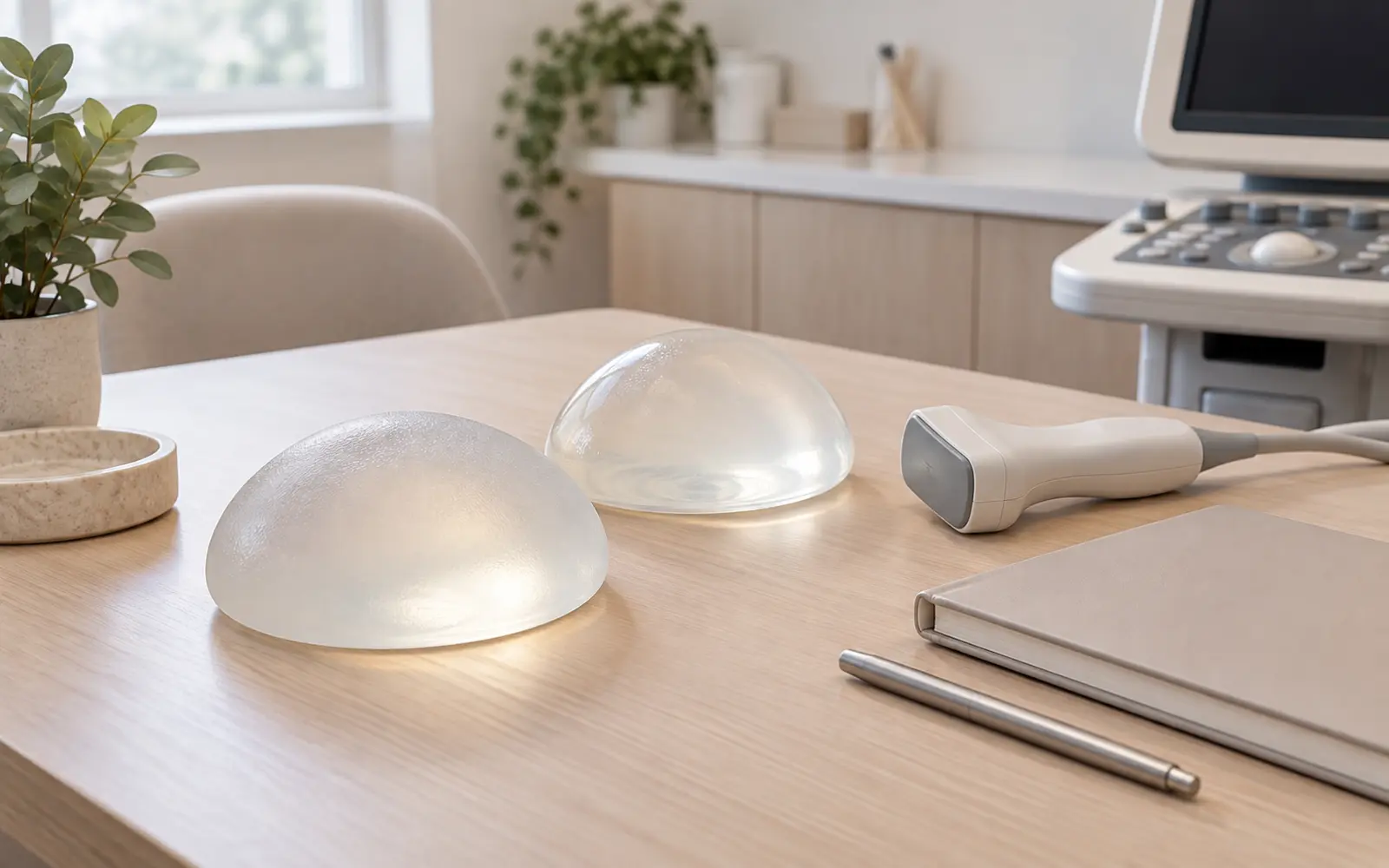
Assessment starts with a detailed history and physical examination. The surgeon asks when firmness began, whether it is changing, and about pain, fever, trauma, prior infection, implant brand and model, and earlier imaging. The examination compares breast shape and softness, implant position, skin and scars, and checks for a mass or fluid.
Ultrasound is not automatically required for every contracture, but it can help when fluid, rupture, a mass or another complication is suspected. A silent silicone implant rupture may not be detected by physical examination alone. The FDA describes MRI as the most effective method for detecting silent silicone rupture and ultrasound as an acceptable screening alternative for patients without symptoms. The choice depends on implant type, symptoms and previous findings.
Our detailed guide to mammography, ultrasound and MRI after breast implants explains the difference between routine surveillance and investigation of a new symptom. Always tell the breast-imaging team that you have implants before a mammogram.
Treatment is individualised. Mild firmness that does not distort the breast or cause pain may be monitored. When there is significant hardness, pain, compression or shape change, surgery may be considered. Options can include surgically releasing the capsule, removing part or all of it, removing or replacing the implant, and changing or reinforcing the implant pocket.
The statement that every capsule must be removed completely “en bloc” is inaccurate. How much capsule should be removed depends on tissue findings, rupture or cancer concern, attachment to the chest wall and the risks of dissection. The FDA explains that leaving the capsule during implant removal can require less dissection, whereas partial or total capsulectomy may be more extensive. Confirmed BIA-ALCL is a separate diagnosis with a specific oncological surgical plan.
Capsular contracture can recur after corrective surgery. That possibility varies with the suspected cause, implant and tissue characteristics, the revised surgical plan and the number of previous procedures. Goals and alternatives should be discussed without promising that recurrence is impossible.
Evidence for nonsurgical treatment of established contracture remains limited. Some medicines and energy-based therapies have been investigated in small studies, but they are not universal, approved or risk-free treatments. The FDA states that it has not cleared or approved any device to treat capsular contracture or reduce its incidence. Do not self-prescribe asthma medicines, vitamins, herbal products or other drugs for this purpose.
Forcefully squeezing an implant to tear the capsule from outside is known as closed capsulotomy. It can cause implant rupture, bleeding and tissue injury; the FDA lists the technique among practices associated with rupture. Postoperative massage is also not suitable for every implant, pocket or stage of healing. Only follow a massage technique and schedule if your own operating surgeon has specifically recommended it.
No method eliminates the risk completely. Careful patient selection and medical history, appropriate implant and pocket planning, control of bleeding and infection, stopping smoking and following postoperative instructions may help reduce modifiable risks. Evidence about implant surface or above- versus below-muscle placement is not, by itself, a product recommendation. Safety profile, anatomy, intended result and current local regulation must be considered together.
Our page on breast augmentation methods and implant selection explains why size, shape, placement and incision planning are individual decisions. Choosing the largest implant, following a social-media trend or deciding on price alone does not remove the need for long-term follow-up.
Breast implants are not considered lifetime devices. Contracture, rupture, displacement or another reason for revision may arise over time. However, implants are not automatically replaced in every symptom-free patient simply because a particular anniversary has passed. Keep your implant card, record the operation date and product details, and attend the follow-up advised for your implant and health history.
Age- and risk-appropriate breast screening continues even when there are no implant symptoms. Implants do not replace or cancel cancer screening. The imaging centre should know about the implants in advance, and an individual plan should be agreed with the relevant radiology and surgical teams.
No. Capsular contracture is tightening of the fibrous capsule. Breast implant-associated anaplastic large cell lymphoma, or BIA-ALCL, is a rare cancer of the immune system that usually develops in fluid or capsule around an implant rather than in the breast tissue itself. The FDA reports that it occurs more often in people with a history of textured-surface implants. One condition does not automatically diagnose the other.
Persistent one-sided swelling, late fluid collection, a mass, pain or a new asymmetry—especially years after implantation—should be investigated. Assessment may include examination, imaging and, when appropriate, sampling of fluid or tissue. It is not safe to assume every late change is “just a capsule” or to try an internet treatment first.
Seek timely medical review for rapidly increasing swelling in one breast, marked redness or warmth, fever, severe or escalating pain, discharge, skin-colour change, a change after trauma or a new lump. Shortness of breath, chest pain, fainting or a severe allergic reaction requires emergency care.
Yes. A thin, flexible capsule is the body’s normal scar-tissue response around an implant. It becomes a problem when it tightens and causes firmness, distortion or pain.
No. Early swelling, muscle tension, implant displacement, fluid, infection or rupture can cause similar symptoms. An in-person assessment is needed to distinguish them.
It may develop within months or appear years later. New or progressive firmness and shape change should be assessed regardless of how long ago surgery took place.
Evidence for nonsurgical treatment of established contracture is limited. Forceful squeezing can damage the implant and tissue; medication or massage should only follow a specific recommendation from your surgeon.
No. The plan depends on severity, pain, distortion, implant condition, imaging and personal goals. Monitoring, capsule surgery, implant exchange or removal are different options.
Yes. Recurrence is possible after corrective surgery. Risk varies with tissue characteristics, the suspected cause, the implant and the planned revision.
No. They are different conditions, although rupture is part of the differential diagnosis when firmness or shape changes. Ultrasound or MRI may be used when indicated.
Seek prompt medical assessment for rapidly increasing one-sided swelling, redness, fever, severe pain, a lump or late fluid. Do not wait for a routine message reply when symptoms may be urgent.
New firmness, shape change, pain or swelling can be reviewed together with your implant card, surgical history and imaging when indicated. An individual follow-up or treatment plan is made only after assessment.
Op. Dr. Bahadır Çelik: This page provides general patient information for the Antalya clinic of Op. Dr. Bahadır Çelik, Specialist in Plastic, Reconstructive and Aesthetic Surgery. Online information does not replace an examination, diagnosis or treatment plan.
Capsular contracture is not the same as implant rupture, infection, seroma or displacement. New firmness, pain or late swelling requires an individual examination and appropriate imaging when indicated.